Short answer
Clothes fit when they follow your shape without pulling or billowing. Check five points in the mirror: shoulder seams sit at the shoulder bone, the chest lies flat, sleeves end at the wrist, the waist stays up without a belt and trousers do not pool at the shoe. A tailor can fix most things except shoulders.
Key takeaways
- Clothes fit when they follow your shape without pulling or billowing, and five checkpoints tell you: shoulders, chest, sleeve, waist and length.
- In a 2013 study, 274 raters who saw each photo for five seconds at most judged the same faceless man as more confident and better paid in a tailored suit than in a similar off-the-rack one.
- Fit rules are tailoring convention, not science, so use them as a starting point and trust the photo.
- A tailor can shorten, taper and take in most garments, but cannot rebuild shoulders or add fabric that is not there.
- Dress the body you have today by buying for your widest point and altering the rest.
Why fit matters more than price
Fit is the part of your clothes you can fix today, on almost any budget, and one experiment shows a small difference in cut changing how a man is rated within five seconds. That it outranks price is a tailor's rule. No study has tested the two against each other.
What the research says
Howlett, Pine, Orakçıoğlu and Fletcher (2013) showed 274 online participants photos of one man with his face pixelated, for a maximum of five seconds per image. He wore either a made-to-measure suit or an off-the-rack suit in the same dark blue herringbone. In the tailored suit he was rated higher on confidence and expected salary, with borderline gains on success and flexibility and no difference on trustworthiness [1]. The limits: one slim model, one pair of suits, small effects, and ratings of status and confidence, not attraction. The made-to-measure suit would also have cost about three times as much, so cut and construction cannot be fully separated. Verdict: Supported, for quick impressions of confidence and status.
Price cues register too. In nine studies, people judged the same face as more competent when it appeared above clothes that independent judges had rated as looking "richer", even when the image was on screen for about an eighth of a second [2]. Those studies varied how expensive the clothes looked. They did not test fit.
That leaves the headline claim untested. We found no study that put an expensive garment that fits badly against a cheap one that fits well. "Fit beats price" is a tailor's rule that we think is right, and you should read it as that. The practical case is simple: you can check fit in ten minutes and correct most of it for the cost of an alteration, with clothes you already own.
Whether well-fitting clothes change how you feel is less certain. The original "enclothed cognition" experiment, in which a lab coat seemed to sharpen attention, failed a preregistered direct replication in 2019 [3]. A 2023 analysis of 105 effects from 40 studies, with 3,789 participants in total, found the early studies shaky and the ones published after 2015 sounder [4]. Two of its three authors wrote the original paper. Count on looking better. Treat feeling better as a bonus.
One more limit. Clothes do not win anyone back. Fit is one visible part of a glow-up after a breakup, next to training and the routine in men's grooming and style basics. All of it sits in the Rebuild yourself guides.
The 10-minute mirror test
Put the outfit on, stand in front of a full-length mirror in daylight and check five points from the top down. Each takes about two minutes, and each is pass or fail.
Set up first. Shoes on. Phone, wallet and keys out of your pockets. Stand the way you normally stand, without pulling your stomach in. Take one photo from the front and one from the side, because the side view shows what the mirror hides.
- Shoulders. Find the seam where the sleeve joins the body. Pass: it sits on the outer edge of your shoulder bone and the fabric lies flat. Fail: it droops down your arm, or it sits toward your neck and the fabric pulls across your upper back.
- Chest. Pass: the fabric lies flat and buttons close without strain. Fail: X-shaped creases around a button, gaps between buttons, or fabric standing away from your chest like a tent.
- Sleeve. Pass: long sleeves end at the wrist bone, where your hand begins, and short sleeves end around mid-bicep. Fail: a cuff that covers your thumb joint, or short sleeves that flare out from the arm.
- Waist. Pass: trousers stay up without a belt, with room for two fingers inside the waistband, and you can pinch one to two inches of shirt at each side. Fail: a belt bunching the waistband, or a tucked shirt ballooning over it.
- Length. Pass: an untucked shirt ends around the middle of your fly, and trouser hems touch the top of the shoe with one shallow fold at most. Fail: a shirt that covers your whole seat, or hems stacked in folds on your shoes.
Then move. Sit down, reach forward, raise your arms. A garment that passes standing but pulls, gapes or rides up when you move has failed.
Sort what you tried into three piles: passes, fixable, gone. Keep the rules in perspective, too. These checkpoints are tailoring convention, refined over a long time. Nobody derived them in a lab, and cuts go in and out of fashion. Use the list as a starting point and trust the photo.
How a T-shirt and polo should fit
A T-shirt or polo should skim your chest and stomach without clinging, with sleeves that end around mid-bicep and a hem around the middle of your fly.
| Checkpoint | Pass | Fail |
|---|---|---|
| Shoulder seam | On the shoulder bone | Hanging down the upper arm |
| Sleeve | Ends mid-bicep and rests lightly on the arm | Reaches the elbow, or flares out |
| Chest and stomach | Skims the body and hangs straight | Clings and shows every line, or hangs like a tent |
| Length | Mid-fly, and still covers your waistband with your arms raised | Shows your stomach when you reach, or covers your seat |
| Collar | Lies flat against the neck | Stretched, wavy or curling |
Fabric weight does a lot of the work. A heavier cotton hangs straight where a thin, stretchy one clings. Check again after the first wash, since cotton can shrink.
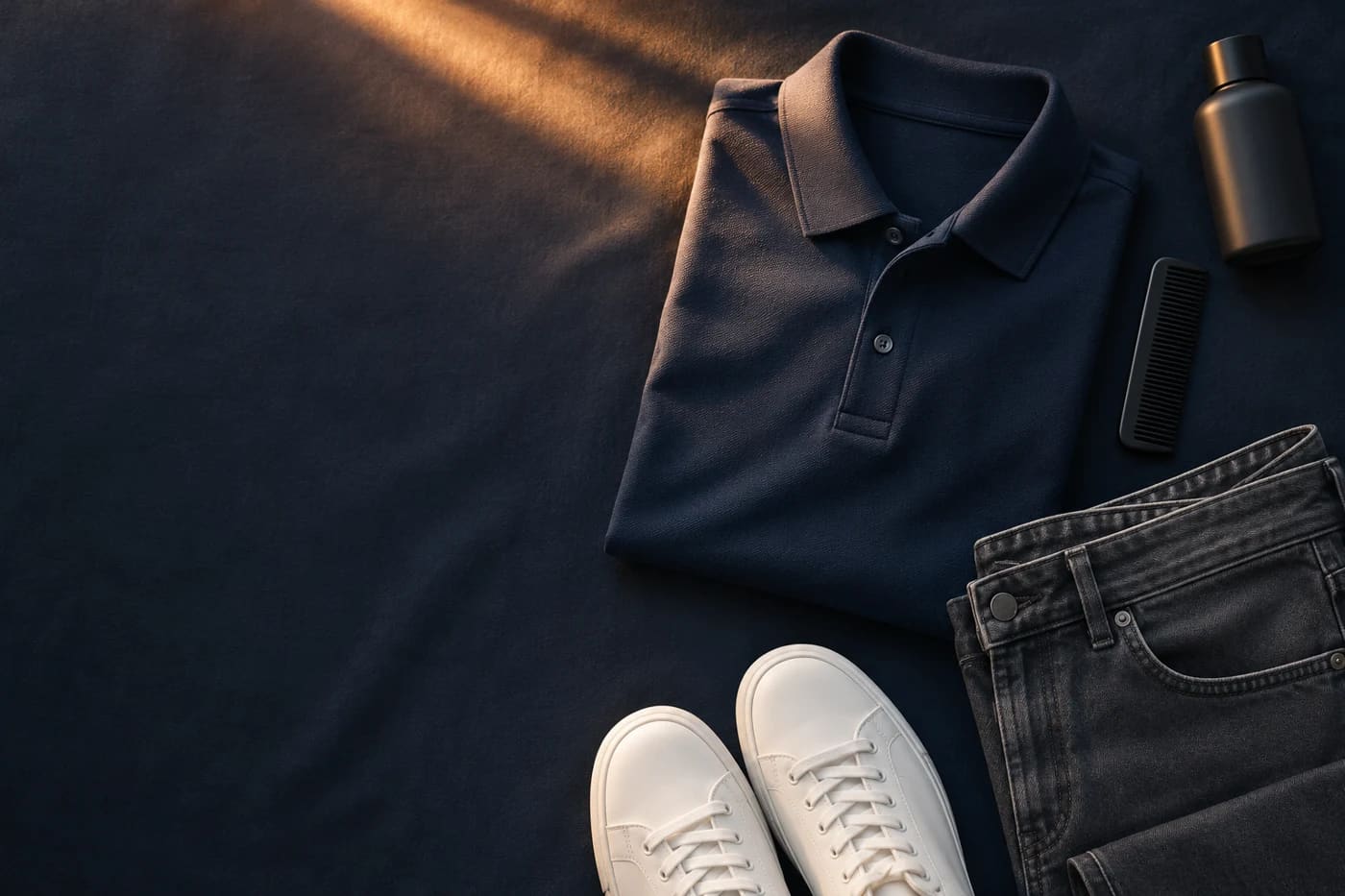
A navy polo that passes all five points, with dark jeans and clean white sneakers, is a complete outfit for most casual settings. That includes the short first dates recommended in how to get a girlfriend.
Altering a T-shirt usually costs more than replacing it, so tailors rarely take the job. Buy the one that fits.
How a shirt should fit
A button-up shirt fits when the collar closes with room for one or two fingers, the shoulder seams sit on the bone, the buttons close flat and the cuff ends at the wrist bone.
| Checkpoint | Pass | Fail |
|---|---|---|
| Collar | Buttoned, with room for one or two fingers | Tight on the neck, or a wide gap all the way around |
| Shoulders | Seam on the shoulder bone | Seam down the arm, or pulling across the back |
| Chest | Buttons lie flat | X-shaped creases, or gaps between buttons |
| Waist | One to two inches to pinch at each side | Fabric billowing over the belt when tucked |
| Sleeve | Cuff at the wrist bone, and it stays there when you bend your arm | Cuff over the palm, or riding up the forearm |
| Length | Stays tucked when you raise your arms, or ends mid-fly if worn untucked | Pulls out when you reach, or hangs past your seat |
"Slim", "tailored" and "regular" mean different things at different stores, so try two cuts in your size before you try two sizes. A shirt that fits the collar and shoulders but is loose through the waist is the easy case: a tailor takes in the sides. If the shoulders or chest are wrong, put it back.
How jeans and chinos should fit
Jeans and chinos fit when the waist stays up without a belt, the seat follows your shape, the leg narrows gently toward the ankle and the hem meets the shoe with one shallow fold at most.
| Checkpoint | Pass | Fail |
|---|---|---|
| Waist | Stays up without a belt, with room for two fingers | Slides down, or digs in when you sit |
| Seat | Follows your shape | Sagging folds under the seat, or pockets pulled open |
| Thigh | About an inch to pinch at each side | Tight lines across the lap when you sit, or loose flapping fabric |
| Leg | Narrows gently from knee to ankle | Wide enough to cover the shoe, or tight on the calf |
| Length | Touches the top of the shoe, one shallow fold at most | Several folds stacked on the shoe |
The fold where the hem meets the shoe is called the break. Current convention favors a slight break or none. Jeans can carry a little more, or one neat cuff. Dark, plain denim with no rips goes with the most other clothes, and a small amount of stretch in the fabric makes a closer cut easier to sit in.
Front pockets that flare open are the quickest tell that a pair is too tight through the hips. Go up a size and have the waist taken in.
How a jacket should fit
A jacket fits when its shoulders end where yours do, it buttons without pulling, the sleeves show a little shirt cuff and the hem covers most of your seat. Get the shoulders right in the store, because nobody can fix them later.
| Checkpoint | Pass | Fail |
|---|---|---|
| Shoulders | The jacket shoulder ends at your shoulder, and the sleeve hangs smooth | A dent below the shoulder edge, or ripples and tightness across the back |
| Collar | Sits flat against your shirt collar | A gap at the back of the neck |
| Button | Closes flat over your stomach | X-shaped creases around the button |
| Sleeve | Shows a quarter to half an inch of shirt cuff | Hides the shirt cuff, or shows more than an inch |
| Length | Covers most of your seat | Ends above your seat, or hangs like a coat |
For casual jackets such as bombers, overshirts and denim jackets, the shoulder rule is the same and the hem sits at the hip.
This is where the suit study applies most directly. The two suits were matched on color and cloth and differed in cut, and the ratings shifted after a look of five seconds or less [1].
What a tailor can fix, and what a tailor cannot
A tailor can make clothes shorter and narrower almost anywhere. A tailor cannot rebuild shoulders or add fabric that is not there. So buy to fit your shoulders and your widest point, then alter the rest.
| Garment | Routine fixes | Possible, ask first | Not worth it |
|---|---|---|---|
| Trousers and jeans | Hem the length, taper the leg, take in the waist | Let out the waist or seat, slim the thigh | Change the rise, rescue a seat that is far too small |
| Shirts | Shorten the sleeves, take in the sides | Shorten the body | Shoulders, collar size, a chest that pulls |
| Jackets | Adjust sleeve length, take in the waist | Shorten the body slightly, correct a collar gap | Shoulders, a chest that is too small, a big change in length |
| T-shirts and polos | None | Shorten the hem | Shoulders, stretched collars |
Taking in is easier than letting out, because letting out depends on spare fabric inside the seam and many garments have little. This table is trade convention and tailors differ, so ask before you buy something that needs work.
Example. "Can you hem these to a slight break with these shoes, and taper the leg from the knee down? What will that cost, and when can I pick them up?"
Bring the shoes you will wear with the trousers. Let the tailor pin the garment on you, and check the mirror before you agree to anything. As a rule of thumb, a garment that needs one or two alterations is a good candidate, and one that needs three or more is usually cheaper to replace.
Dress the body you have today: bigger, slim, short and tall builds
The same five checkpoints apply to every build. What changes is where off-the-rack sizing tends to fail you, and which alteration fixes it.
Buy for the body you have now. Clothes that fit today look better today, and they can be altered or replaced if your measurements change. If you are following a workout plan after a breakup, re-run the mirror test every couple of months.
| Build | Where off-the-rack goes wrong | What usually works |
|---|---|---|
| Bigger | Sizing up for the chest or stomach leaves shoulders, sleeves and length too big | Fit your widest point, then have sleeves and hems taken up. Pick fabric with some weight that hangs straight. Avoid both clinging and tenting. |
| Slim | Regular cuts billow at the waist and sleeves | Slim or tailored cuts, with the sides taken in. An overshirt or jacket adds structure. Close-fitting, not skin-tight. |
| Shorter | Sleeves, hems and shirt bodies run long | Hem everything. Keep untucked shirts at mid-fly and trousers at a slight break or none. Look for short lengths. |
| Taller | Sleeves and inseams run short, and shirts come untucked | Tall or long sizes add length without width. Check the cuff at the wrist with your arm bent. |
The right-hand column is stylist convention. None of it has been tested in a study, and no build is a problem to hide. The aim is clothes that follow your shape.
What about slimming rules?
Dark colors, vertical stripes, "never wear horizontal stripes": these are conventions too, and the one that has been tested did not hold up. In a set of small perception experiments, with 8 to 12 observers each, a line-drawn figure in horizontal stripes had to be made about 6 percent wider at the hips to look the same width as one in vertical stripes. With photos of a mannequin viewed in stereo 3D, the gap was about 11 percent [5]. That is the opposite of the folk rule. A follow-up with 30 students found the effect was stronger for thin figures, may reverse for larger ones and varied widely from viewer to viewer [6].
Taken together, the effects are small and inconsistent, and nobody in these experiments was looking at a real man in a real shirt. Wear the pattern you like, and put your effort into the five checkpoints. For where fit sits among the other things research links to attraction, see how to be more attractive as a man.
Do this today
Run the mirror test on the outfit you wear most often. Full-length mirror, shoes on, pockets empty, one photo from the front and one from the side. Check the five points and write down each fail. That is 10 minutes. If the only fails are sleeve or trouser length, drop the piece at a tailor this week.
Then replace what failed. In the free four-week plan, "Fix the fit" is a Week 1 move on both paths: the same mirror check, then an online order today for anything that fails it, in your real size from a shop with free returns. No account needed. Fix the fit in the free plan.
Questions men ask
How do I know if my clothes are too big?
Look for spare fabric where there should be none. The shoulder seam hangs past your shoulder bone, the cuff covers part of your hand, you can pinch more than two inches of shirt at each side of your waist, the trouser seat sags, or the hem stacks in folds on your shoe. One of these means the cut is wrong for you. Two or more usually means the garment is at least a size too big.
Should I size down?
Only if the smaller size passes at the shoulders and chest without pulling. Most men in clothes that are too big need a slimmer cut in the same size, or one size down, not a tight fit. Check the buttons. If the fabric pulls into an X around a button, or a T-shirt clings to your stomach, go back up a size and have a tailor take in the waist or sleeves instead.
Where should trousers break?
The break is the fold where the trouser hem meets your shoe. Current tailoring convention favors a slight break or none: the hem touches the top of the shoe with one shallow fold at most. Jeans can carry a little more, or one neat cuff. If the fabric stacks in several folds, have the trousers hemmed. It is one of the simplest jobs a tailor does, so bring the shoes you will wear.
Do vertical stripes really make you look slimmer?
Probably not. In small perception experiments, a figure in horizontal stripes had to be drawn wider to look the same width as one in vertical stripes, which is the opposite of the folk rule. A follow-up with 30 students found the effect varied a lot between viewers and may reverse for larger figures. The effects are small either way. Fit, and fabric that hangs straight, matter more than the direction of a stripe.
Sources
Every source below was opened during drafting and review. The note under each one says who was studied and what it cannot show.
Howlett, Pine, Orakçıoğlu, Fletcher (2013). The influence of clothing on first impressions: Rapid and positive responses to minor changes in male attire. Journal of Fashion Marketing and Management, 17(1), 38-48.
274 online participants, most of them women, rated one faceless male model in two similar suits for up to five seconds; one model, small effects, and it measured impressions of confidence and success, not attraction.
Oh, Shafir, Todorov (2020). Economic status cues from clothes affect perceived competence from faces. Nature Human Behaviour, 4(3), 287-293.
Nine studies in which people rated the competence of faces shown with clothing that judges saw as richer or poorer (the abstract gives no participant totals); the studies varied how expensive clothes looked, not how they fit.
Burns, Fox, Greenstein, Olbright, Montgomery (2019). An old task in new clothes: A preregistered direct replication attempt of enclothed cognition effects on Stroop performance. Journal of Experimental Social Psychology, 83, 150-156.
A preregistered direct replication of the 2012 lab-coat attention experiment (the abstract gives no sample size) that found no effect of the coat; it tests one task, not every claimed clothing effect.
Horton, Adam, Galinsky (2023). Evaluating the Evidence for Enclothed Cognition: Z-Curve and Meta-Analyses. Personality and Social Psychology Bulletin, 51(2), 203-221 (published online 2023).
Z-curve and meta-analysis of 105 effects from 40 studies (3,789 participants); two of the three authors wrote the original enclothed cognition paper, and the outcomes are lab measures of thinking and behavior, not attraction.
Thompson, Mikellidou (2011). Applying the Helmholtz illusion to fashion: horizontal stripes won't make you look fatter. i-Perception, 2(1), 69-76.
Four small perception experiments with 8 to 12 observers each, using striped squares, line drawings, cylinders and photos of a mannequin; very small samples and no real clothed people.
Ashida, Kuraguchi, Miyoshi (2013). Helmholtz illusion makes you look fit only when you are already fit, but not for everyone. i-Perception, 4(5), 347-351.
A short report in which 30 undergraduates compared computer-drawn thin and fat figures in striped shirts; one small sample, and results varied widely between viewers and with the order of testing.