Short answer
Start with what shows first: a haircut you can maintain, a clean beard line or a clean shave, a 10-minute daily routine (shower, deodorant, teeth, skin, nails) and three outfits that fit. Fix fit before buying anything. This is practical advice on first impressions, not proof that any look creates attraction.
Key takeaways
- A maintained haircut, a sharp beard line or clean shave, and clothes that fit change how you come across before any product does.
- The daily routine takes about 10 minutes: shower, face, deodorant, teeth, hair, and a beard or shave check.
- In one study, 274 raters who saw each photo for five seconds at most scored the same man higher on confidence and expected salary in a tailored suit than in a similar off-the-rack one.
- Studies on facial hair disagree, favoring light stubble, heavy stubble or beards in turn, so keep the version you can keep tidy.
- Grooming and clothes do not win anyone back; they make you presentable, and that part is fully in your control.
Tick off the cut and the fit in the free plan
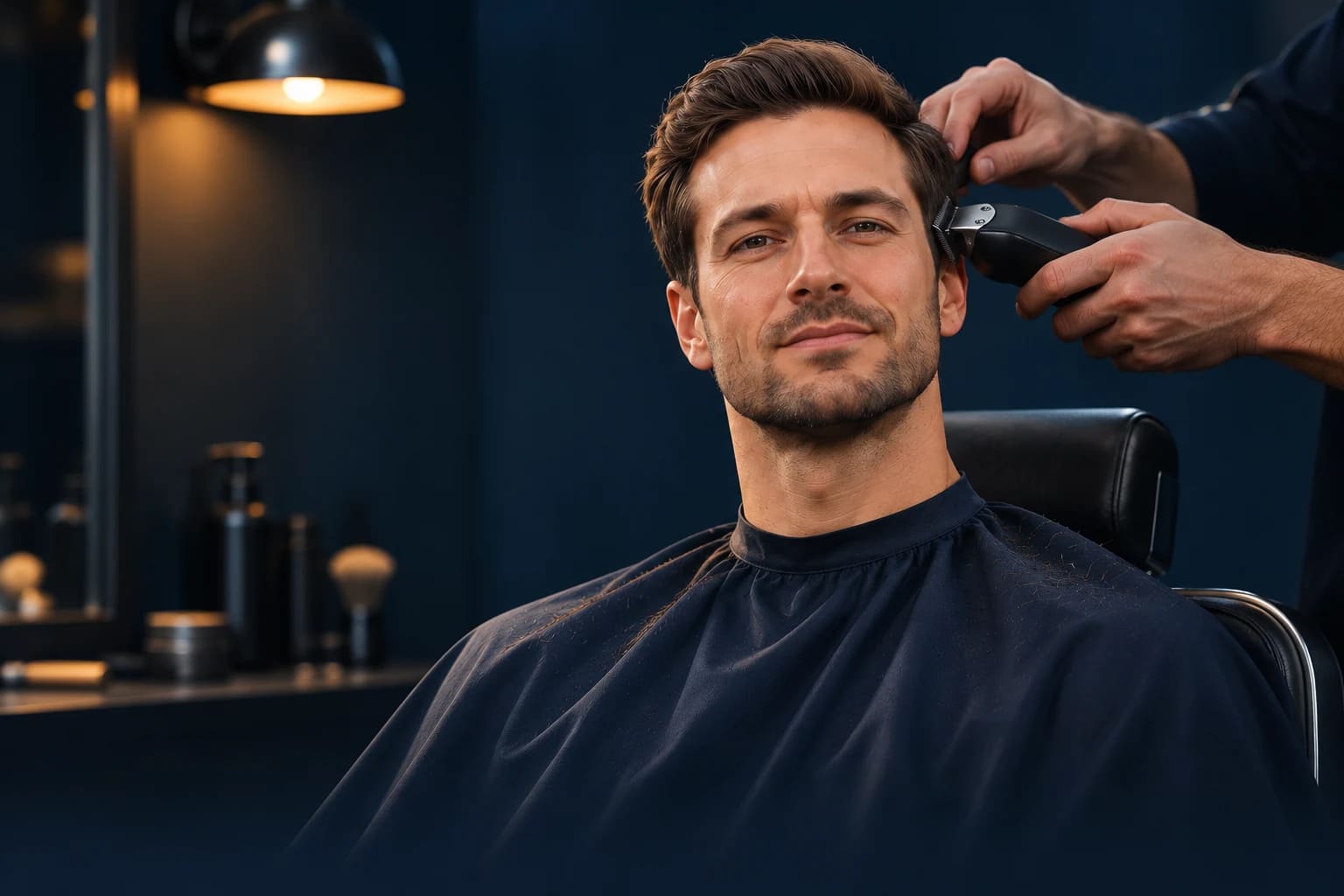
What changes first impressions fastest
The things that show from across a room change first impressions fastest: your haircut, your beard line or shave, whether your clothes fit, and whether you look and smell clean. Products come last. That order is our judgment: we found no study that ranks these against each other.
People size you up in seconds, and clothing alone can move the result. In a 2013 study, 274 people looked at photos of the same man with his face pixelated, for no more than five seconds per photo. In half the photos he wore a made-to-measure suit. In the other half he wore an off-the-rack suit matched to it for color (dark blue) and cloth. The tailored version scored higher on confidence and expected salary, with smaller, borderline gains on success and flexibility. Trustworthiness did not move [1]. The only thing that changed between photos was the cut.
Keep that finding in its lane. It measured impressions of confidence and success, and nobody was asked whether they found him attractive. It used one slim model and one pair of suits. Take it as a reason to fix the visible basics first. It does not prove that a look makes anyone want you.
So work in the order the change shows:
- Hair. A cut you can style in a minute and keep up every few weeks.
- Face. A clean shave, or a beard with a clear neckline and cheek line.
- Fit. Three outfits that pass a mirror check.
- Clean. A daily routine that handles skin, teeth, nails and smell without thought.
If you are rebuilding after a split, this is the quickest visible part of a glow-up after a breakup. It sits alongside training and discipline in the Rebuild yourself guides.
The 10-minute daily grooming routine
A daily grooming routine for men needs seven steps and about 10 minutes: shower, face, deodorant, teeth, moisturizer if you need it, hair, and a beard or shave check. Run it in the same order every morning so it stops being a decision.
- Shower (4 minutes). Soap where you sweat: underarms, groin, feet. Wash your hair as often as it needs it.
- Face (1 minute). The American Academy of Dermatology's basics are simple: a gentle, alcohol-free cleanser, lukewarm water, fingertips instead of a washcloth. It suggests washing morning and night, and after heavy sweating [2].
- Deodorant (30 seconds). On dry skin, every day, before you dress.
- Teeth (2 minutes). The American Dental Association says to brush twice a day with a soft-bristled brush and fluoride toothpaste, and to clean between your teeth once a day [3].
- Moisturizer (30 seconds). The same dermatology guidance says to use one if your skin is dry or itchy [2]. Plain and unscented is enough.
- Hair (1 minute). Towel dry, add a small amount of product if your cut needs it, and shape it with your fingers or a comb.
- Beard or shave check (1 minute). Run a trimmer over strays or shave, then check the neckline in the mirror. Look at your nails while you are there.
At night, repeat the face wash and the teeth. That is three more minutes.
The routine is dull on purpose. Its job is to take the question of whether you look and smell alright off your mind, so your attention can go to the person in front of you. It is also one small promise kept every morning, which is how confidence after a breakup gets rebuilt.
One limit: this routine is hygiene. It treats nothing. For acne that will not settle, a rash, or anything on your skin that worries you, see a dermatologist or your doctor.
Weekly and monthly: the short checklist
Once a week, handle nails, beard edges, stray hairs and laundry. Every few weeks, get the haircut. Every three or four months, replace the toothbrush.
| How often | What to do | Why it matters |
|---|---|---|
| Weekly | Trim fingernails and clean under them | Hands get seen up close, across a table |
| Weekly | Re-cut the beard neckline and cheek line, or tidy the back of your neck | Edges blur before anything else does |
| Weekly | Trim visible nose and ear hair | Small, and noticed at talking distance |
| Weekly | Wash towels, sheets and gym clothes, and wipe down your everyday shoes | Smell lives in fabric |
| Every 5 to 7 shaves | Change the razor blade | Dermatology guidance, to reduce irritation [4] |
| Every 2 to 6 weeks | Haircut | Short fades lose their shape in 2 to 4 weeks, longer cuts hold for 4 to 6 |
| Monthly | Trim toenails, and check collars, cuffs and shoes for wear | Worn edges make a good outfit look tired |
| Every 3 to 4 months | Replace your toothbrush | Dental guidance, sooner if the bristles fray [3] |
The haircut interval is barber convention. No study sets it. The practical test is the mirror: when the hair around your ears and neck looks fuzzy, you are overdue.
Put the weekly items on one fixed evening. Sunday works because it sets up the week. It runs on the same mechanism as building self-discipline: a fixed time and a short list, so there is nothing left to decide.
What to tell your barber
Tell your barber three things: how short on the sides, how much length on top, and how much time you will spend styling it each morning. Bring one or two photos of the cut on a man whose hair is like yours.
"Just a trim" gives him nothing to work with, so you get his default. Specifics get you a cut that suits your head and your routine.
The four details that matter
- Sides and back. Give a clipper guard number, or say "scissors, over the ears" if you want it longer.
- Top. Give a length in inches, or say how you wear it: pushed to the side, forward or back.
- Neckline. Tapered fades out and grows out cleanly. Squared looks sharp for a week and then shows regrowth.
- Your morning. "I will spend one minute on it" changes what he cuts.
Guard numbers mean the same length on most clippers. Brands vary slightly, so confirm with him.
| Guard | Hair left |
|---|---|
| #1 | 1/8 inch (3 mm) |
| #2 | 1/4 inch (6 mm) |
| #3 | 3/8 inch (10 mm) |
| #4 | 1/2 inch (13 mm) |
Example. "Number 2 on the sides, blended up into about two inches on top, tapered at the neck. I want to style it in under a minute and have it still look tidy in four weeks. Is there anything you would change for my hairline?"
Ask that last question every time. A good barber sees the cowlick, the receding corner or the flat crown that you do not, and adjusts the cut around it.
Before you leave the chair, ask what product he used and how much, watch how he styles it, and book the next appointment. If your hair is thinning, ask his view on length. Most barbers will suggest going shorter. That is trade convention, and nobody has tested it. Questions about hair loss itself belong with a doctor or dermatologist.
Beard, stubble or clean shaven: keep what you can keep sharp
Keep the version you can keep even and edged. The research on which one looks best is mixed, so upkeep is a better guide than any ranking.
What the research says
Three studies, three answers. Neave and Shields (2008) had 60 women rate 15 computer-generated male faces, and light stubble came out most attractive [5]. Dixson and Brooks (2013) photographed 10 men clean-shaven, at 5 days of growth, at 10 days and fully bearded. Women rated heavy stubble highest, with full beards, light stubble and clean-shaven faces lower [6]. Dixson and colleagues (2016) had 8,520 women rate digitally altered faces, and facial hair raised ratings for a long-term partner but not for a short-term one [7]. The limits: these are ratings of photos and computer images, each study built on a small set of faces (three designs in the first, ten men in the second) and averaged across raters. None followed real meetings. Verdict: Mixed.
We found no study that compared a tidy beard with a neglected one. That a kept beard beats a scruffy one is our judgment and every barber's. Nobody has measured it.
| Option | Suits you when | Upkeep |
|---|---|---|
| Clean shave | Growth is patchy, or you want the simplest sharp look | Shave every 1 to 2 days |
| Stubble | Growth is even across cheeks and jaw | Trimmer every 2 to 3 days, neckline weekly |
| Short beard | Coverage is full, with no gaps | Trim weekly, edge the neck and cheeks weekly, wash it when you wash your face |
Where the lines go
The neckline is a curve from behind one earlobe to the other, passing a finger or two above your Adam's apple. Shave everything below it. The cheek line follows the natural upper edge of your beard: clear the strays above it and leave the line itself alone. These are barber conventions, and your barber will set both lines for you if you ask. After that you only have to follow them.
Shaving without irritation
The American Academy of Dermatology's shaving advice is short: shave right after a shower, use a cream or gel, shave in the direction the hair grows, and change the blade after five to seven shaves [4]. If shaving keeps leaving bumps or a rash, see a dermatologist.
How to smell good without overdoing it
Smelling good is mostly the absence of bad smells: a clean body, clean clothes and clean teeth. Fragrance is optional, and it should only reach someone standing close to you.
Work through it in this order:
- Body. Daily shower, deodorant on dry skin.
- Clothes. A fresh shirt, underwear and socks every day. Wash gym clothes after each session. Give shoes a day to dry between wears.
- Breath. Brush twice a day and clean between your teeth [3]. If bad breath persists, see a dentist.
- Home. Wash towels and sheets weekly. Clothes pick up the smell of the room they are stored in.
- Fragrance, if you want it. One or two sprays on your chest or neck. Do not stack it on top of scented body wash and scented deodorant. If someone can smell it from more than an arm's length away, it is too much.
The spray count and the arm's-length test are conventions too. No study sets either.
What the research says
Roberts and colleagues (2009) ran a double-blind test. Men received either a deodorant spray with fragrance and antimicrobial ingredients or an identical-looking spray without them. Over several days, the men using the active spray reported higher self-confidence. Women then rated video clips of the men, with no smell involved, and rated the active-spray group as more attractive. Ratings of still photos showed no difference between the groups [8]. The limits: it is one study, the abstract gives no sample size, and two of the six authors worked for Unilever, a deodorant manufacturer. Verdict: Mixed.
The authors' reading is that the men using the active spray behaved differently, and it showed on video. Nothing in the study shows that a scent attracts anyone.
Style basics: fix fit first, then three go-to outfits
Fix fit before you buy anything, then settle on three outfits you can put on without thinking: everyday, smart casual and one for occasions. Three covers almost every week of your life.
The fit check is quick. The shoulder seam sits on your shoulder bone, buttons close without pulling, sleeves end at the wrist, and trousers stay up without a belt and do not pool on your shoes. The full walk-through, garment by garment, is in how clothes should fit a man. The suit study above is the reason fit comes first: a small difference in cut changed ratings in five seconds [1].
| Outfit | Pieces | Wear it for |
|---|---|---|
| Everyday | Navy polo or plain T-shirt, dark jeans, clean white sneakers | Most days, casual drinks, errands |
| Smart casual | White or light blue button-up shirt, dark chinos or dark jeans, leather shoes or boots, plus a plain sweater or overshirt when it is cold | A first date, dinner, a work event |
| Occasion | Navy or charcoal jacket, white shirt, dark trousers, leather shoes | Weddings, interviews, anything with a dress code |
Keep the colors to navy, gray, white and one earth tone such as olive or tan. Choose solid fabrics and small logos, or none. Then every piece works with every other piece, and getting dressed takes two minutes.
Whether better clothes make you feel more confident is less settled than the headlines suggest. The 2012 lab-coat experiment that launched the idea of "enclothed cognition" failed a preregistered direct replication in 2019 [9]. A 2023 analysis of 105 effects from 40 studies, covering 3,789 participants, raised doubts about the early studies and found sounder evidence in those published after 2015 [10]. Two of its three authors wrote the original paper. Treat a confidence lift as a possible bonus. The gain you can count on is that you stop thinking about what you are wearing.
Be clear about what this buys you. Clothes and grooming do not win a woman back, and no study says they do. They change how strangers read you in the first seconds and how you carry yourself. If this reset follows a breakup, do it for how you show up. A new look is not a message to her. If she has asked for no contact, blocked you, or there is a legal order in place, respect it. A haircut does not change that.
Presentable gets you into the conversation. What happens next is covered in how to be more attractive as a man and how to get a girlfriend.
What to buy, in order, on a budget
Spend nothing first. Then buy in the order the change shows: alterations, haircut, routine basics, jeans that fit, two plain tops, clean sneakers, one button-up shirt.
- Audit what you own. Run the fit check on everything you wear. Make three piles: fits, fixable, gone.
- Alter the fixable pile. Hemming trousers and shortening sleeves are routine jobs for any tailor or alterations counter. Ask the price before you leave anything.
- Get the haircut. It is the quickest visible change you can pay for.
- Buy the routine basics. Cleanser or plain soap, deodorant, a soft toothbrush, fluoride toothpaste, floss, nail clippers, and a razor or trimmer. Store brands are fine.
- One pair of dark jeans that fit. No rips, no heavy fading.
- Two plain tops. A navy polo and a white or gray T-shirt.
- Clean white sneakers. Or scrub the pair you have.
- One button-up shirt. White or light blue.
- Later. A jacket, leather shoes, a second pair of trousers.
There are no brand names here on purpose, and no affiliate links. Secondhand and outlet pieces are fine when they fit. Stop buying once you have three outfits. More clothes do not fix a missing routine.
Do this today
Book a haircut for this week. Pick a barber, pick a slot, then save two photos of a cut you like on a man with hair like yours and copy the barber script above into your phone notes. That takes about ten minutes, and it puts a date on the first visible change.
Then put the rest on rails. Week 1 of the free four-week plan includes the moves "Get the cut" and "Fix the fit": book the barber now, then run a mirror check on what you own and order what fails it online. One move at a time, with no account and your progress saved on your device. Tick off the cut and the fit in the free plan.
Questions men ask
What grooming products does a man actually need?
Fewer than the shelf suggests. A gentle face cleanser or plain soap, deodorant, a soft toothbrush with fluoride toothpaste, something to clean between your teeth, nail clippers, a comb, and a razor or beard trimmer. Add a plain moisturizer if your skin gets dry and one hair product if your cut needs it. Store brands do the job. For a skin condition, see a dermatologist instead of buying more products.
How often should men get a haircut?
No research sets this, only barber convention. Short, faded cuts lose their shape in two to four weeks, and medium-length cuts hold for four to six. The practical rule is to book the next cut before you leave the chair and to go when the hair around your ears and neck starts to look fuzzy. A quick neck tidy at home stretches the gap between visits.
Do women prefer beards or clean shaven?
Studies disagree, which tells you there is no single answer. One study of 60 women rating computer-generated faces favored light stubble. Another, using photos of 10 men, found women rated heavy stubble highest. A third, with 8,520 women, found facial hair raised ratings for a long-term partner but not a short-term one. These are averaged photo ratings. Keep the version you can keep clean and even.
How do I dress better on a budget?
Start with what you own. Run the fit check, keep what passes and have a tailor hem or take in pieces that are close. Then buy in this order: dark jeans that fit, two plain T-shirts or polos, clean sneakers, one button-up shirt. Stick to navy, gray, white and one earth tone so everything works together. A secondhand piece with a small alteration usually looks better than a new one that hangs loose.
Should I get a new haircut after a breakup?
If your current cut is overgrown, or you have kept it for years out of habit, yes. A fresh cut is a quick, low-cost reset and a good first promise to keep. Choose something you can maintain and skip drastic changes made at midnight. Do it for how you show up, not as a signal to her. A no-contact request, a block or a legal order still stands, and a new look is not a reason to reach out.
Sources
Every source below was opened during drafting and review. The note under each one says who was studied and what it cannot show.
Howlett, Pine, Orakçıoğlu, Fletcher (2013). The influence of clothing on first impressions: Rapid and positive responses to minor changes in male attire. Journal of Fashion Marketing and Management, 17(1), 38-48.
274 online participants, most of them women, rated one faceless male model in two similar suits for up to five seconds; one model, small effects, and it measured impressions of confidence and success, not attraction.
American Academy of Dermatology (2026). Face washing 101. American Academy of Dermatology (public guidance page, accessed November 2026).
Professional-body guidance for the general public, not a study; it covers everyday face washing and does not replace seeing a dermatologist about a skin condition.
American Dental Association (2026). Brushing Your Teeth. MouthHealthy, American Dental Association (public guidance page, accessed November 2026).
Professional-body guidance for the general public, not a study; it gives general brushing advice and does not replace a visit to a dentist.
American Academy of Dermatology (2026). Hair removal: How to shave. American Academy of Dermatology (public guidance page, accessed November 2026).
Professional-body guidance for the general public, not a study; general shaving tips that do not cover persistent irritation, which needs a dermatologist.
Neave, Shields (2008). The effects of facial hair manipulation on female perceptions of attractiveness, masculinity, and dominance in male faces. Personality and Individual Differences, 45(5), 373-377.
60 women rated 15 computer-generated male faces (three face designs at five levels of facial hair); a small sample judging artificial images, not real men.
Dixson, Brooks (2013). The role of facial hair in women's perceptions of men's attractiveness, health, masculinity and parenting abilities. Evolution and Human Behavior, 34(3), 236-241.
Photos of 10 men at four stages of beard growth, rated by women and men; only ten faces and photo ratings only, and because the journal page would not open for us, the design and result were checked against the authors' later papers and news coverage of the study.
Dixson, Sulikowski, Gouda-Vossos, Rantala, Brooks (2016). The masculinity paradox: facial masculinity and beardedness interact to determine women's ratings of men's facial attractiveness. Journal of Evolutionary Biology, 29(11), 2311-2320.
8,520 women rated computer-manipulated male faces for general, short-term or long-term attractiveness; digitally altered images in a rating task, not real encounters.
Roberts, Little, Lyndon, Roberts, Havlicek, Wright (2009). Manipulation of body odour alters men's self-confidence and judgements of their visual attractiveness by women. International Journal of Cosmetic Science, 31(1), 47-54.
Men given an active or an inactive deodorant spray in a double-blind design, then rated by a panel of women; the abstract gives no sample size and two of the six authors were Unilever employees.
Burns, Fox, Greenstein, Olbright, Montgomery (2019). An old task in new clothes: A preregistered direct replication attempt of enclothed cognition effects on Stroop performance. Journal of Experimental Social Psychology, 83, 150-156.
A preregistered direct replication of the 2012 lab-coat attention experiment (the abstract gives no sample size) that found no effect of the coat; it tests one task, not every claimed clothing effect.
Horton, Adam, Galinsky (2023). Evaluating the Evidence for Enclothed Cognition: Z-Curve and Meta-Analyses. Personality and Social Psychology Bulletin, 51(2), 203-221 (published online 2023).
Z-curve and meta-analysis of 105 effects from 40 studies (3,789 participants); two of the three authors wrote the original enclothed cognition paper, and the outcomes are lab measures of thinking and behavior, not attraction.